One of the challenges facing the healthcare industry for years is ensuring the security of patient data while also allowing access to it for those who are authorized. Cybercriminals actively seek Electronic Health Records (EHRs), which document information on diagnoses, medications, and test results as well as deeply personal medical history. Millions of patient records are compromised due to various kinds of healthcare data breaches every single year, thereby jeopardizing patients’ privacy and bilking the healthcare institutions into millions of dollars in remediation and legal costs. Data from a traditional central repository has been used in the healthcare sector for decades, but increasingly these are not as secure as they ought to be. Blockchain technology could usher in a major paradigm shift in the security of EHRs as it creates unalterable and decentralized records with data or patient identities remaining private even as it is shared across care networks.
The Current EHR Security Challenge
There are few places that hold as much information related to personal and medical history as electronic health records do, making them a prime target of the hacker. Medical identities are permanent and much more difficult to discover once used and alter than credit card numbers. Today most EHR platforms are based on a single server with all patient information stored there—a single point of failure that’s the target of sophisticated attacks. Firewall and encryption tools waste an incredible number of resources for hospitals/clinical centers as well as access control while the breaches go on.
It becomes even more challenging where patients require services from several healthcare providers. Moving information between systems involves transferring information across vulnerable channels, typically in an outdated format and through manual means. This disarticulation leads to security concerns and can be a problem when medical records are not instantly accessible for critical care decisions.
How does Blockchain provide Immutable Records?
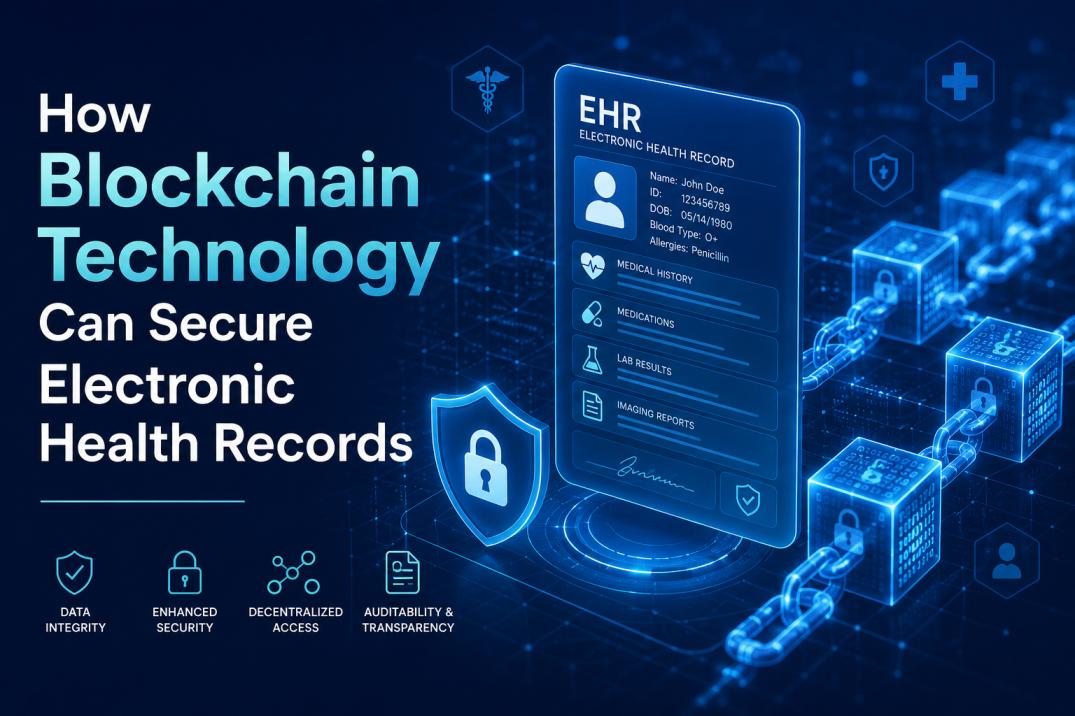
In essence, Blockchain technology completely alters the way health data is stored and retrieved. Instead of having all the patient information stored in one central system, blockchain establishes a distributed ledger system which stores multiple copies of patient information on different nodes, each of which has been authorized to access and interpret the information. Every transaction, from being added, the diagnosises, lab results and prescriptions, are documented on a set of fixed blocks that are cryptographically connected to the previous blocks in the chain.
The cryptographic security that blockchain security features makes it virtually impossible to tamper. As a new record is inserted it is obtained with a hash, using similar mathematical functions of a SHA256 Generator, Subscript Generator that will create a unique digital fingerprint. Changing the historical record would involve recalculating all later hashes on the whole network to begin with, which is too hard to do. This immutability ensures that hospitals and patients will know that medical records have not been tampered with or fabricated.
Patient Control and Decentralization
With the traditional EHR systems, patients have limited access to their own information. They ask for records, have to wait records to be processed, and have little knowledge about who accesses their information. The blockchain-based health records change that, by empowering the patient with control over their health data. Doctors, specialists and hospitals will be able to be accessed by patients at any time, without the help of an intermediary institution, and can be granted and denied the right to access.
By decentralizing the system, there’s no central authority to verify transactions. Instead, a complex network of healthcare wellbeing institutes and official nodes are connected and cooperate in order to validate new records. Users are responsible for keeping their encryption keys and healthcare providers will not be able to read their data without permission. This establishes a trustworthy system, in which security isn’t reliant on the skills and assets of any individual hospital or clinic.
Integrating Health Systems and Providers
Another major benefit of blockchain to the healthcare sector is to address the issue of interoperability. No currently available EHR system is able to readily interoperate with each other, leading patients to have to repeat the history of their care or duplicate tests between different providers. With a blockchain system, a universal ledger will be established, enabling simultaneous access by all authorized healthcare stakeholders without requiring their own IT system to be compatible with the other.

Physicians can have access to the patient’s full medical history, medications and allergies, as well as recent test results, when the patient visits an ER in another city. This does away with harmful holding-up time and prevents harmful drug interactions due to lack of information. Because of the transparency of the blockchain, all access to patients’ records can be recorded, making them open for review and audit, and giving patients visibility into what users have accessed and when.
Security of Cryptography for Privacy Protection
Advanced cryptographic tools help to protect patient privacy, yet while blockchain is transparent, every information is protected. Healthcare systems store encrypted data and only the patient has the keys to decrypt it; it is not the data that is placed on the blockchain.Not the actual medical data is placed on the blockchain, only the encrypted data is stored and the keys used to decrypt that data are kept by the patient only. The blockchain does not store data, it is an immutability data layer and access control mechanism.
The hybrid has been used where the advantages of blockchain security and transparency are paired with the capabilities of solid encryption technology. Patients control access to the medical providers’ records via smart contracts, permission rule-Enforcers. A smart contract can automatically authorize the oncologist to view the information regarding cancer, and can limit access to psychiatric data unless they give permission.
Challenges of implementation and solutions
Although there’s undeniable promise in blockchain, there are also considerable challenges for healthcare organizations to jump. Breaking legacy EHR with blockchain technology will require major investment and training. Blockchains need to be designed from the ground up to ensure regulatory compliance with HIPAA and other healthcare privacy laws.
The blockchain network’s computational demands must also be optimized for healthcare environments. Some blockchain implementations adopt private blockchains with fewer nodes, which enhances the speed of the chains, but not quite as secure as public blockchains—it means that there is reduced decentralization.
Conclusion
A blockchain is a total change of how EHRs can be secured and managed. Medical blockchain’s decentralized nature and immutability safeguard patient privacy, and it gives patients more control over their health data. The decentralization and immutability of healthcare blockchain help overcome the inherent weaknesses of centralized EHR systems by enhancing patient privacy and giving patients greater control over their health data.
In an era where healthcare organizations are battling data breaches, data fragmentation, and the need for greater security and interoperability, blockchain-based solutions represent a potential solution that could empower patients with control over their health information. Although this change won’t occur overnight, it’s worth the investment for health systems that embrace being early adopters in healthcare security.

Salman Zafar is the Founder of Health Loops. He is a professional blogger and content creator with expertise across different subjects, including health, environment, tech, business, marketing and much more